
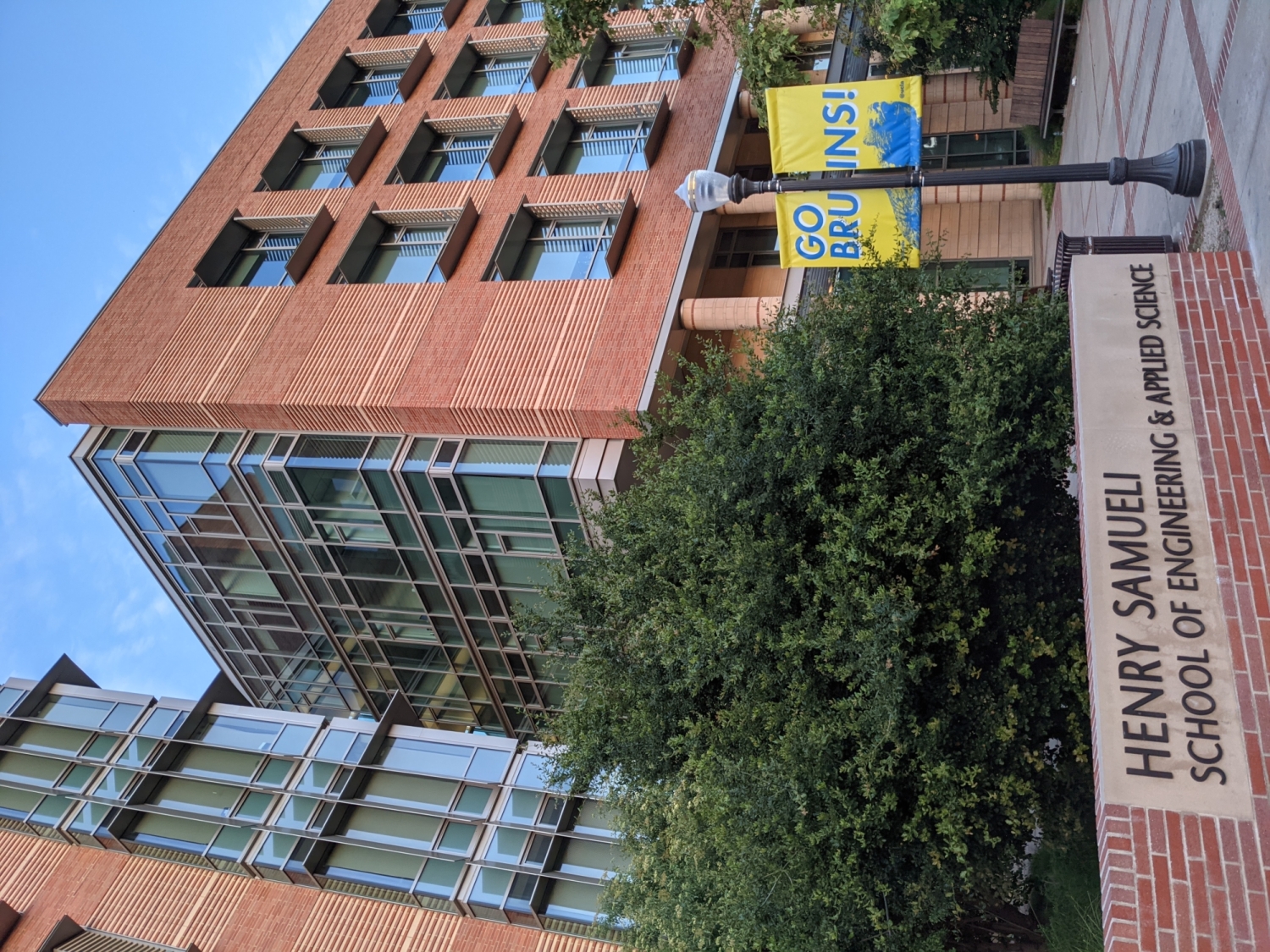
Welcome to the Wireless Lab at UCLA, directed by Prof. Ian Roberts.
We conduct research on wireless communication and sensing in the Samueli School of Engineering at UCLA.
We use a variety of mathematical tools, machine learning, and hardware platforms to analyze, model, optimize, and prototype wireless systems and solutions.
Research Publications Google Scholar
Email: ianroberts [at] ucla [dot] edu
Lab: 54-147B Engr IV · Ian's Office: 56-147A Engr IV
Transmit and receive with SDRs over the internet as if they were connected directly to your computer.
We are excited to introduce RemoteRF, an open-source software package that facilitates the creation of large-scale testbeds of distributed SDRs that can be accessed over the internet via Python.
If you are a prospective undergraduate/graduate student, postdoc, or visiting researcher interested in joining our lab, please fill out this form.
If you are a prospective graduate student interested in joining our lab, please apply to the electrical and computer engineering program at UCLA. The application deadline is December 15. Include my name (Ian Roberts) in your application.
Unfortunately, I cannot always promptly respond to every email I receive, but I will do my best.
About the Wireless Lab
In the Wireless Lab at UCLA, we use mathematical tools, machine learning, and real-world hardware to analyze, model, optimize, and prototype wireless systems and solutions. We are particularly interested in conducting research and creating innovative technologies to drive the design, development, and deployment of future 6G cellular networks.
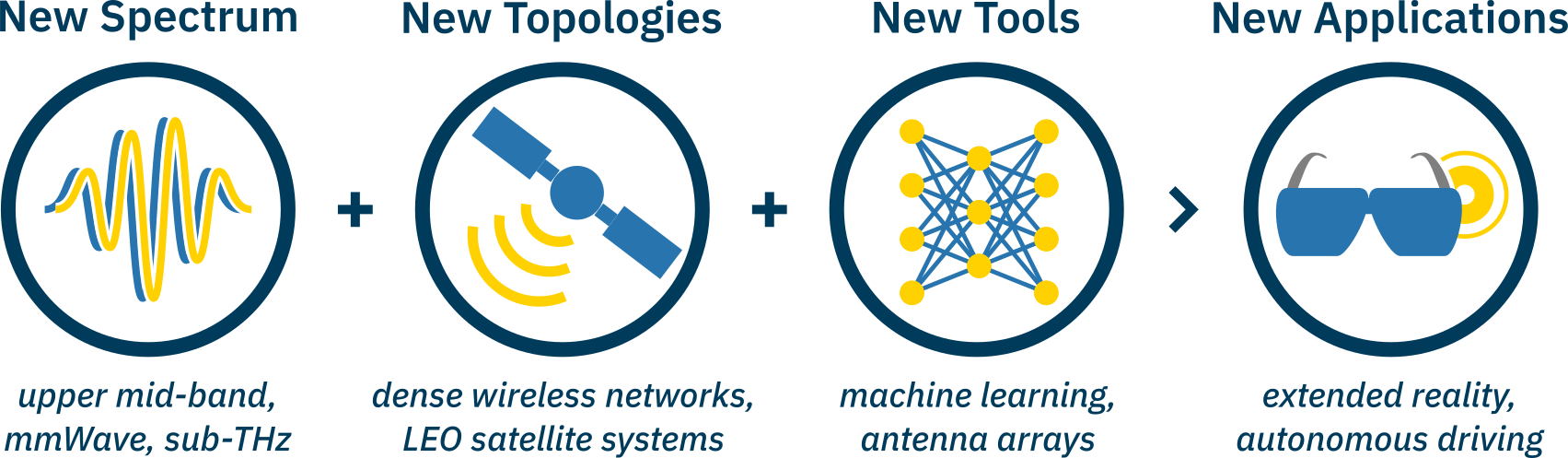
We conduct research on a variety of topics in wireless, all of which have relevant applications in next-generation wireless communication systems. Broadly speaking, our work aims to strengthen the existing foundation of 5G networks while also introducing transformative technologies for 6G networks. In this pursuit, our current projects are on the following research topics, all of which we expect to have real-world impact on future wireless connectivity:
- Full-Duplex Wireless Systems — to increase throughput, reduce latency, and broaden coverage;
- Satellite Communication Systems — to deliver near-global wireless connectivity;
- Intelligent Beam Alignment — to efficiently deploy high-frequency communication systems;
- Joint Communication and Sensing — to enable emerging and unforeseen applications.

We are excited and optimistic about the future of wireless connectivity and the roles it will have in society. We pride ourselves on conducting meaningful research that can have real-world impact. Here are some of our papers we recommend you read if you’re interested in our work:
- Millimeter-Wave Full Duplex Radios: New Challenges and Techniques
- LoneSTAR: Analog Beamforming Codebooks for Full-Duplex Millimeter Wave Systems
- STEER: Beam Selection for Full-Duplex Millimeter Wave Communication Systems
- Real-World Evaluation of Full-Duplex Millimeter Wave Communication Systems
- Active Beam Learning for Full-Duplex Wireless Systems
- Site-Specific Beamforming for Full-Duplex Massive MIMO Systems via Implicit Channel Estimation
- Satellite Selection for In-Band Coexistence of Dense LEO Networks
- A Survey on Advancements in THz Technology for 6G: Systems, Circuits, Antennas, and Experiments
- RemoteRF: An Open-Source Platform to Democratize Access to Software-Defined Radios in Wireless Research and Education
Our Lab’s Mission
We have many motivations for what we do in the Wireless Lab at UCLA. At the core of everything we do is our mission to continually accomplish three overarching goals:
- to conduct meaningful research that advances wireless connectivity;
- to educate and train wireless engineers capable of solving real-world problems;
- to excite others about the underlying technologies connecting our world.
We strive to accomplish this mission through the combination of research, education, mentorship, and outreach.
Three Recent Publications
Spectrum Sharing Among Broadband LEO Mega-Constellations: Interference Regulations and Coexistence Mechanisms
by I. P. Roberts · September 2026
Examining spectrum regulations and coexistence mechanisms for broadband LEO satellite mega-constellations.
PDF arXiv
A Deep Iterative Refinement Receiver for OTFS Symbol Detection in Doubly-Dispersive Channels
by E. Ispir and I. P. Roberts · August 2026
Iteratively suppressing interference to improve OTFS symbol detection in doubly-dispersive channels.
PDF arXiv
Rainbow Beamforming for Wideband LEO Satellite Communications: Principles, Applications, and Technical Challenges
by J. Park, H. Ko, H. Kim, N. Lee, I. P. Roberts, H. V. Poor, and W. Shin · July 2026
IEEE Wireless Communications
Exploiting beam squint to create frequency-spatial diversity and dynamic beam allocation for LEO SatCom.
PDF arXiv
All Publications ⇢︎ Google Scholar ↗︎
Recent News
- August 2026: Hanju concluded a successful research visit with the Wireless Lab at UCLA and returned to Yonsei University. It was a pleasure having you, Hanju!
- June 2026: Sungho, Kanishka, and Dominic graduated with their M.S. degrees in Electrical and Computer Engineering from UCLA. Congratulations! Dominic will be sticking around for Ph.D.
- June 2026: We released our preprint on RemoteRF, an open-source platform to democratize access to software-defined radios in wireless research and education. The companion website is live at remoterf.net, where you will find documentation on deploying your own instance of RemoteRF. Nice job, Ethan!
- May 2026: Our preprint on site-specific beamforming for full-duplex massive MIMO systems via implicit channel estimation is now available. Nice job, Samuel!
- January 2026: Our paper on TDD in LEO SatCom systems has been published in IEEE Wireless Communications. Nice job, Hyunwoo!
About UCLA
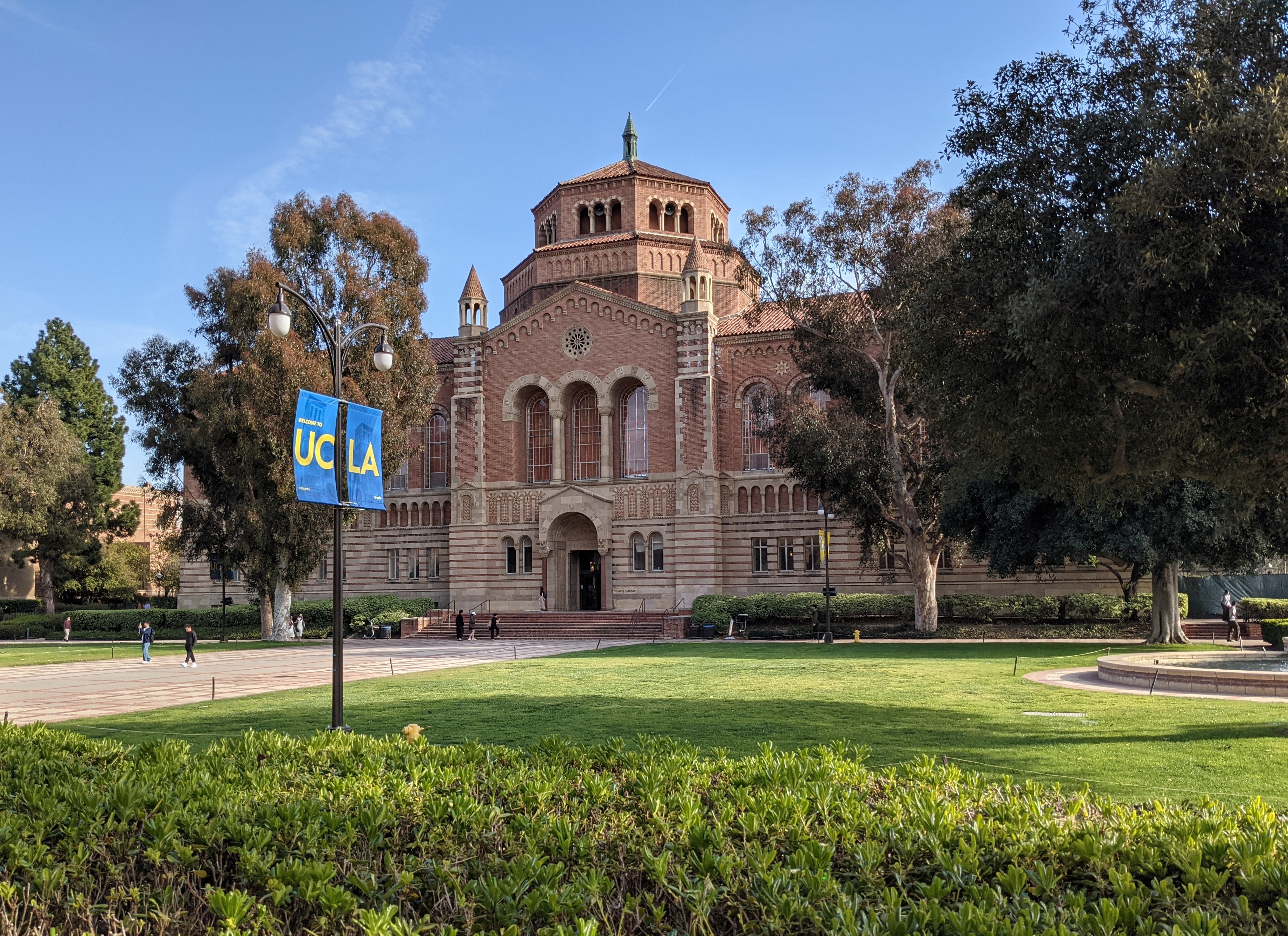
UCLA is located on a large, beautiful campus in the Westwood neighborhood of Los Angeles, California. It is consistently ranked among the top universities in the world, both holistically and across many indvidual fields including engineering. UCLA is particularly unique in that it is exceptionally well-rounded, offering first-class opportunities, education, and training for people of all intrests and backgrounds.
The electrical and computer engineering (ECE) department at UCLA includes some of the most accomplished researchers in their respective disciplines. Courses offered by UCLA ECE faculty are designed to equip students with strong analytical foundations and relevant practical skills that are necessary to succeed in industry, academia, and government labs.
In particular, UCLA is regarded as one of the top schools in the world for students interested in wireless communication and sensing. For such students, UCLA ECE offers a broad range of courses covering every aspect of wireless systems: from theory to implementation. We offer courses on signal processing for communications, wireless communication theory, multi-antenna communications, RF circuit design, antenna theory, information theory, communication networks, optimization, and machine learning, along with several others. Following graduation, UCLA ECE students go on to develop cutting-edge technologies at companies such as Qualcomm, Broadcom, Viasat, Samsung, Google, Apple, Intel, Cisco, NVIDIA, Ericsson, Nokia, IBM, and countless others.
Contact
Please reach out if you are interested in collaborating with us or would like additional information on our work.
Email: ianroberts [at] ucla [dot] edu
Lab: 54-147B Engr IV
Ian’s Office: 56-147A Engr IV